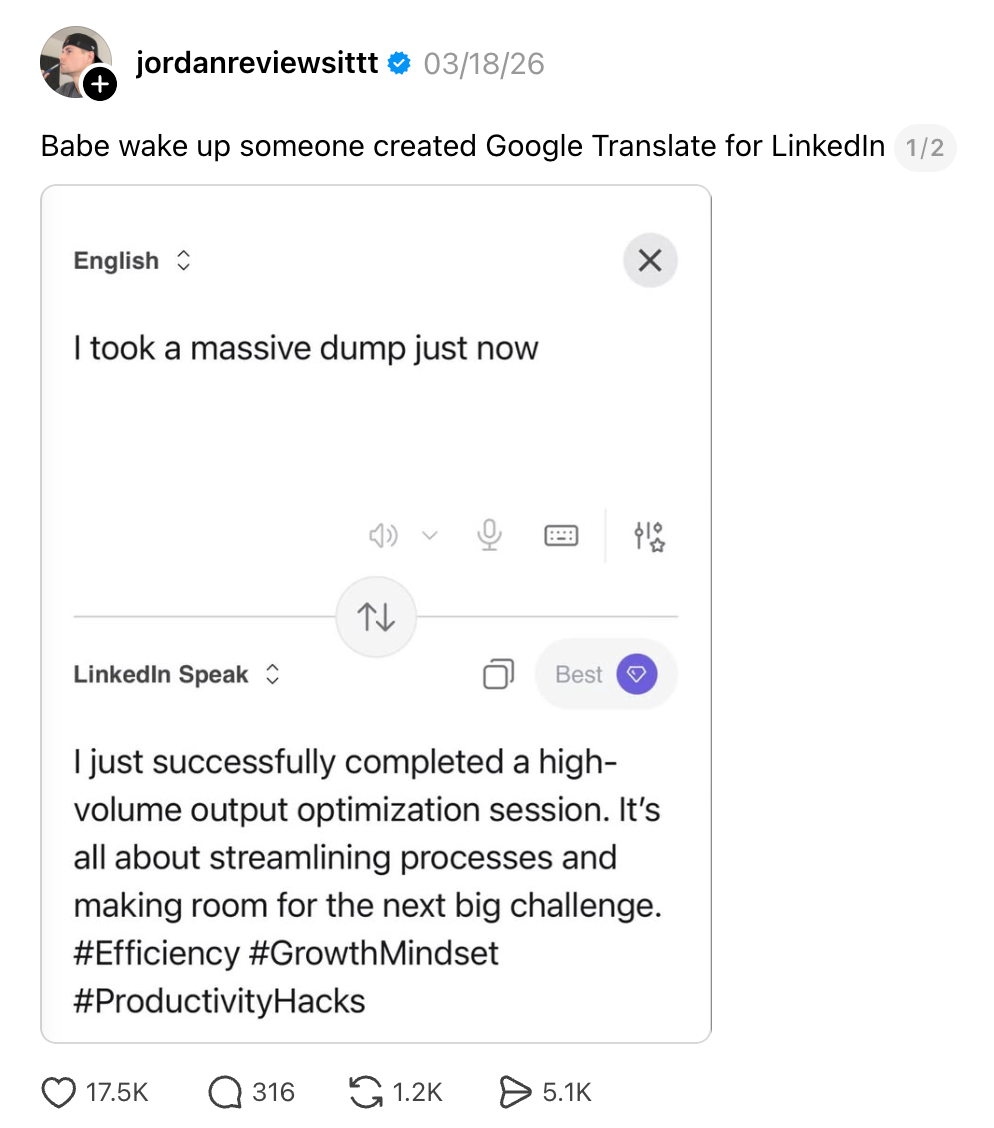
Recently, Kagi Translate went viral on social media. It’s essentially a wrapper around an LLM with the prompt “translate this in the style of X”. You can already do that with any AI chatbot. So why did this blow up?
The format
A Kagi’s screenshot is very easy to understand: input on top, output on bottom, a clear label showing the translator mode. A ChatGPT screenshot requires parsing a conversation thread, reading a prompt, understanding the context. With Kagi, people understand right away what it is and how it works.
It’s a new toy, not another ChatGPT screenshot
This type of content already went viral during ChatGPT’s early day. But ChatGPT screenshots are stale now. Kagi repackages the same trick as a standalone product, which makes it feel new again.
The product puts the idea into your head
The idea of “translate my sentence into LinkedIn speak” doesn’t just occur to people staring at ChatGPT’s blank text box. Kagi makes you realize there exists a quirky translator, even though the capability already exists in the AI chatbot you’re using.
There are many interesting ideas that are so obvious in retrospect, but people still get surprised because we didn’t think about those ideas (e.g. knowing the basic terminology will get you up to speed in a new field).
It’s easier to remix
As a result of realizing there’s a quirky translator, people start using and trying different variants.
The “trying” process in Kagi is more convenient than in ChatGPT: you choose a mode (you can just type what mode you want btw — the AI will understand the assignment), try different inputs and see the results as you type. With ChatGPT, you type the content plus the translation instruction → enter → wait → type again → …
Easy to remix means more people sharing their content.